Sankyo Robot Maintenance Training Report: October 21, 2009
Introduction
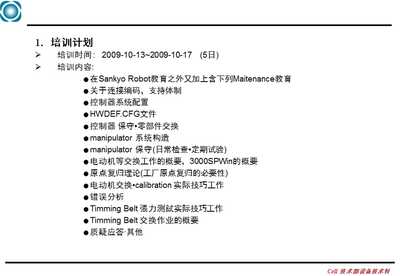
This report documents the Sankyo robot maintenance training conducted on October 21, 2009, aimed at enhancing participants' English language skills within the technical context of robot maintenance. The training focused on equipping technicians with the necessary English terminology and communication abilities to effectively carry out maintenance tasks on Sankyo robots, ensuring safety and operational efficiency.
Training Objectives
The primary objectives of this training were to:
- Familiarize participants with English technical terms related to Sankyo robot components and maintenance procedures.
- Develop the ability to read and understand English maintenance manuals and safety instructions.
- Improve verbal communication skills for reporting issues and coordinating with international teams.
- Enhance written English skills for documenting maintenance activities and reports.
- Foster confidence in using English during routine and emergency maintenance scenarios.
Training Content
1. Technical Vocabulary
Participants were introduced to key English terms associated with Sankyo robots, including:
- Components: servo motor, controller, encoder, reducer, gripper, end effector.
- Actions: calibrate, troubleshoot, diagnose, replace, lubricate, inspect.
- Safety terms: emergency stop, lockout/tagout, PPE (Personal Protective Equipment), hazard.
- Documentation: maintenance log, checklist, incident report, spare parts list.
2. Reading and Comprehension
Trainees practiced reading and interpreting excerpts from Sankyo robot maintenance manuals in English. Emphasis was placed on:
- Understanding step-by-step procedures.
- Identifying warnings and cautions.
- Interpreting technical diagrams and labels.
- Extracting key information from troubleshooting guides.
3. Listening and Speaking
Interactive sessions included:
- Listening to audio recordings of maintenance scenarios and answering comprehension questions.
- Role-playing typical conversations, such as reporting a malfunction, requesting assistance, and giving instructions.
- Practicing pronunciation of technical terms and common phrases used in maintenance contexts.
4. Writing Skills
Participants engaged in writing tasks relevant to their daily work:
- Completing maintenance checklists in English.
- Writing brief incident reports describing problems and actions taken.
- Drafting emails to request spare parts or clarify technical issues.
5. Practical Application
A hands-on component allowed trainees to apply their English skills while performing simulated maintenance tasks. They were required to:
- Follow English instructions to perform a routine inspection.
- Verbally explain the steps they were taking.
- Document the maintenance performed in English.
Training Methodology
The training employed a communicative approach, combining:
- Presentation: Instructor-led sessions introducing vocabulary and concepts.
- Practice: Pair and group activities for speaking and listening.
- Production: Tasks requiring trainees to use English independently.
- Feedback: Continuous assessment and correction by the instructor.
Real-world materials, such as actual Sankyo manuals and maintenance forms, were used to ensure relevance and practicality.
Participant Performance
All participants actively engaged in the training activities. Pre- and post-training assessments showed significant improvement in technical vocabulary recognition and reading comprehension. Speaking confidence also increased, although some participants required additional practice in pronunciation and fluency.
Recommendations
Based on the training outcomes, the following recommendations are made:
- Conduct follow-up sessions focusing on advanced troubleshooting vocabulary and complex instructions.
- Provide English language support materials, such as glossaries and phrasebooks, for daily reference.
- Encourage technicians to use English in routine documentation to reinforce learning.
- Arrange periodic refresher training to maintain and further develop language skills.
Conclusion
The Sankyo robot maintenance English training on October 21, 2009, successfully addressed the language needs of maintenance personnel. By integrating technical content with language learning, participants gained practical skills that will enhance their effectiveness in maintaining Sankyo robots. Continued practice and reinforcement are essential to sustain and build upon these gains.
Appendix
- Attendance list
- Training agenda
- Pre- and post-training assessment results
- Sample maintenance checklist in English
Report prepared by: [Trainer's Name]
Date: October 22, 2009
如若转载,请注明出处:http://www.lynzaus.com/product/43.html
更新时间:2026-10-29 01:36:36